Introduction
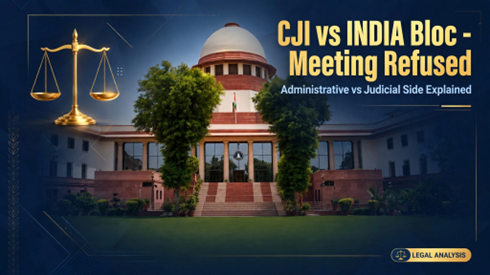
On 11 October 2026, media reports stated that Chief Justice of India Justice Surya Kant had declined a meeting requested by Rahul Gandhi and Mallikarjun Kharge for 12 October 2026. The proposed memorandum reportedly concerned the Chief Election Commissioner and the Election Commission of India, as well as issues relating to student arrests and restrictions on public transport in Delhi.
According to the reported correspondence, the CJI considered that the issues were already before the Supreme Court and that discussing pending matters through an administrative meeting would be inconsistent with separation of powers and judicial propriety. He reportedly indicated that the appropriate course was to invoke the Court's judicial jurisdiction through established procedures. These statements should be attributed to the reported correspondence, rather than presented as an independent judicial ruling on the merits of the underlying disputes.
The Background and Issues Raised
The reported concerns relate broadly to the functioning of the Election Commission of India and aspects of electoral administration. Depending on the memorandum actually submitted or proposed, these may include questions about electoral-roll revision, voter verification, and the transparency or verification of voting systems. The article should identify only those subjects that are confirmed by the memorandum or reliable reporting, rather than assuming that every issue has been raised in this particular request.
Allegations of bias, irregularity or procedural failure should be attributed to the people or organisations making them. They should not be described as established facts unless supported by a court finding or verifiable evidence.
Why Might an Informal Meeting Be Declined?
A key distinction is the difference between an informal meeting with the head of the judiciary and a matter being heard through the Court’s formal procedures. Where related proceedings are pending, discussing the substance of a dispute outside the judicial process may raise concerns about fairness, transparency and the appearance of impartiality.
The constitutional principle of separation of powers also requires courts to perform their judicial role independently, rather than act as informal administrative supervisors of other constitutional bodies. Formal proceedings provide a structured process in which parties can place their claims, evidence and legal arguments before the appropriate bench.
However, a decision to decline one particular meeting should not be overstated as a universal legal rule that the Supreme Court is prohibited from every meeting with a political delegation. The article should describe the reasons reported in this instance and avoid claiming a broader prohibition unless supported by authoritative legal material.
The Proper Legal Routes
The Constitution of India and election laws provide mechanisms for challenging government action, electoral decisions and alleged violations of constitutional rights. The appropriate legal route depends on the nature of the grievance, the relief sought, the stage of the electoral process and the requirements of the applicable law.
Article 32 and Article 226
Article 32 guarantees the right to approach the Supreme Court for the enforcement of fundamental rights. Article 226 empowers High Courts to issue directions, orders and writs for the enforcement of fundamental rights and for other purposes within their constitutional jurisdiction.
Although both provisions provide constitutional remedies, they differ in scope and application. The appropriate forum depends on the nature of the grievance, the relief sought and any applicable constitutional or statutory restrictions. It would therefore be inaccurate to suggest that every electoral complaint must necessarily be filed under Article 32, or that every electoral grievance is automatically maintainable under Article 226.
In the context of the CJI’s refusal to meet INDIA alliance leaders, the distinction between an administrative representation and a judicial petition is particularly relevant. The CJI reportedly advised the leaders to approach the Supreme Court through the judicial process rather than seek an administrative meeting concerning matters already pending before the Court.
Electoral Rolls and Election-Related Challenges
The Representation of the People Act, 1950, governs matters including the preparation and revision of electoral rolls. The Representation of the People Act, 1951, addresses other aspects of elections, including election petitions and challenges to election results. The applicable procedure depends on the particular dispute.
Consequently, allegations of wrongful inclusion or deletion of voters, procedural irregularities in electoral-roll revision and challenges to a completed election should not automatically be treated as the same legal issue. Each requires examination of the relevant facts, statutory provisions and available remedies. Constitutional remedies may also be relevant where an enforceable fundamental right is alleged to have been violated, subject to the applicable legal restrictions.
Removal of the Chief Election Commissioner
Article 324(5) of the Constitution provides the Chief Election Commissioner with a specific safeguard against removal: the CEC cannot be removed except in the same manner and on the same grounds as a judge of the Supreme Court. Other Election Commissioners and Regional Commissioners cannot be removed from office except on the recommendation of the Chief Election Commissioner.
This constitutional protection should not be loosely described as ordinary impeachment, nor should removal be confused with a legal challenge to a particular decision of the Election Commission. A demand for the CEC’s resignation, a request for the CEC’s removal under the constitutional procedure, and a challenge to an electoral decision are distinct matters involving different legal questions.
Accordingly, allegations of electoral irregularities and demands for the CEC’s removal must be assessed separately, according to the relevant constitutional provisions and legal procedures.
EVMs, VVPAT and Electoral-Roll Revision
Where allegations concern Electronic Voting Machines (EVMs), Voter Verifiable Paper Audit Trail (VVPAT) verification or the Special Intensive Revision (SIR) of electoral rolls, the article should identify the specific relief requested, the persons or organisations making the request, the supporting evidence and the applicable legal framework.
In its judgment of 26 April 2024, the Supreme Court declined to order a return to paper ballots or 100% counting of VVPAT slips, while directing additional safeguards, including the preservation of symbol-loading-unit records and a facility for verification of the burnt memory of microcontrollers in 5% of EVMs per Assembly constituency or Assembly segment, upon a request by eligible candidates under the prescribed conditions. The judgment should be consulted before describing any proposed audit percentage or technical disclosure as a legal entitlement.
The article should distinguish allegations of wrongful voter deletion or irregularities in the revision process from the legal question of whether the Election Commission has authority to conduct an SIR. The Supreme Court upheld the legality of the specific Bihar SIR exercise in its judgment dated 27 May 2026; the scope of that ruling should not be overstated as resolving every factual dispute concerning electoral rolls throughout India
Political demands and judicial findings: A demand made by a political party, an allegation supported by documents and a proposition accepted by a court are three different things. They should be identified and reported separately. Where proceedings are pending, the article should accurately state their procedural status and any relevant judicial orders. For example, the INDIA bloc leaders’ petition concerning alleged SIR irregularities was reported as not listed for hearing on 13 October 2026 because registry defects remained to be corrected. That procedural development should not be represented as a judicial decision on the merits of the allegations.
What the Episode Does—and Does Not—Establish
The reported refusal to hold a meeting illustrates the distinction between informal representations to the Chief Justice of India and the formal adjudication of legal disputes. By itself, the refusal neither establishes nor disproves the Opposition’s allegations concerning electoral irregularities, nor does it determine the merits of any pending or proposed legal proceedings. Those questions must be assessed on the evidence, the applicable law and the decisions of the competent court.
Political parties and elected representatives have a legitimate role in raising public concerns about electoral processes and seeking accountability from constitutional authorities. At the same time, judicial independence, procedural fairness and the impartial adjudication of disputes require that judicial decisions be made in accordance with the law and the material properly placed before the court, rather than through informal political representations.
The central distinction is between access to a meeting and access to justice. The refusal of an administrative meeting does not, by itself, establish a denial of judicial remedy. Equally, directing political representatives to pursue a formal legal process does not resolve the substance of their allegations or establish that the available remedy will be adequate in the particular circumstances. Those issues must be assessed independently, under the Constitution and applicable law.
Conclusion
The reported decision to decline a meeting with INDIA bloc leaders highlights the importance of judicial independence, procedural fairness and the distinction between informal administrative representations and formal judicial proceedings. Where electoral concerns raise questions of constitutional or statutory law, the appropriate course is to pursue the remedies available under the Constitution and applicable election laws, supported by specific facts and relevant evidence.
A balanced assessment must avoid concluding the available record. The refusal of a meeting does not amount to a judicial determination of the underlying allegations, nor does it establish that those allegations are either true or false. Equally, the refusal should not be characterised as evidence of a blanket constitutional prohibition on meeting political representatives unless authoritative legal sources support that interpretation.
Ultimately, electoral grievances must be assessed on their individual merits and addressed through the procedures prescribed by law. The legitimacy of the process depends not only on judicial independence but also on the fair application of legal standards, reasoned judicial decisions and the availability of appropriate remedies where legal violations are established.
Publication note: This article is a legal commentary, not a judicial finding.