
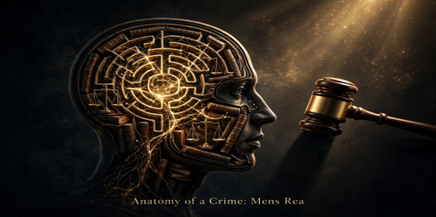
Introduction: Beyond The Act Itself
Imagine two people who cause the same physical harm. One acts deliberately after planning the consequence; the other causes it in a genuine accident while taking reasonable care. The outward result may look similar, but criminal law does not invariably treat the two situations alike. It asks not only what happened, but also what the law required the person to intend, know, foresee or do.
That inquiry is commonly described by the Latin expression mens rea—often translated as a “guilty mind”. It is a foundational concept in criminal jurisprudence because it helps distinguish deliberate wrongdoing from accident, honest mistake and conduct that may be morally blameworthy but does not satisfy the ingredients of a particular offence. Yet mens rea is not a universal formula that can be applied identically to every charge. The mental element required depends on the language, structure and purpose of the provision creating the offence.
In India, the principal general penal statute is now the Bharatiya Nyaya Sanhita, 2023 (BNS), which came into force on 1 July 2024, subject to the exception concerning section 106(2) under the commencement notification. The BNS replaced the Indian Penal Code, 1860 (IPC), for offences governed by the new legislation. Accordingly, the date of the alleged conduct is important in determining the applicable penal law. Conduct occurring before the commencement of the BNS must be examined under the applicable former law, subject to the repeal-and-savings provisions under section 358 BNS and the constitutional protection against retrospective criminalisation and retrospective enhancement of punishment under Article 20(1) of the Constitution of India.
This article examines the meaning of mens rea, its relationship with the physical element of an offence, the role of intention and knowledge, statutory exceptions, evidentiary proof, corporate criminal liability and the approach of the Supreme Court of India. It is intended as legal information, not a substitute for advice on the facts of a particular case.
The Two Core Components: Actus Reus And Mens Rea
Actus Reus: The Prohibited Conduct
Actus reus is commonly used to describe the external or physical element of an offence. Depending on the provision, it may consist of an act, an illegal omission, a prohibited result, a particular circumstance, or a combination of these. The prosecution must establish the conduct and other external elements specified by the statute; a harmful outcome by itself does not automatically establish every element of a crime.
Mens Rea: The Required Mental Element
Mens rea refers to the mental state that the offence requires. Depending on the statutory wording, that state may be intention, knowledge, dishonesty, fraudulence, reason to believe, or another specified form of awareness or fault. These expressions are not interchangeable. Their meaning must be understood in the context of the particular offence and its statutory definition.
Why The Distinction Matters
Suppose a person takes another’s property. Whether the conduct amounts to theft cannot be decided merely by proving that the property changed hands. The prosecution must establish the ingredients of theft under the applicable statute, including the relevant dishonest intention. Conversely, where a statute creates an offence without requiring proof of a particular mental state, the court must interpret that provision on its own terms rather than automatically importing an intention requirement.
The central question is therefore not simply, “Was the accused acting with a bad mind?” It is: “Has the prosecution proved each element of the offence charged, including the mental element that the law requires?”
Intention, Knowledge, Motive And Negligence
Intention
Intention generally concerns the consequence or conduct that a person means to bring about. It may be inferred from circumstances such as the nature of the act, the instrument used, the force applied, the words spoken, prior conduct and what the accused did before or after the event. No single circumstance is necessarily conclusive. Intention is ordinarily assessed from the evidence as a whole.
Knowledge
Knowledge concerns awareness of a fact or of the likely consequence of conduct. A person may not desire a particular consequence yet act with awareness that it is likely to occur. Some offences distinguish expressly between intention and knowledge; the distinction can materially affect the applicable charge and punishment. Courts must apply the formulation chosen by the legislature.
Motive Is Not The Same As Intention
Motive is the reason that may explain why a person acted—for example, revenge, financial gain or fear. Intention concerns the mental state directed towards the act or consequence. Evidence of motive may support an inference about intention, but motive is not invariably an essential ingredient of an offence, and the absence of an apparent motive does not automatically defeat a prosecution where the required ingredients are otherwise proved.
Negligence And Recklessness
Indian criminal law does not employ recklessness as a uniform, independently defined mental element across all offences. Statutory provisions instead use expressions such as rashness, negligence, intention and knowledge, each of which must be interpreted according to its language and applicable judicial precedents. In particular, criminal negligence must be distinguished from ordinary civil negligence. In Jacob Mathew v. State of Punjab, (2005) 6 SCC 1, the Supreme Court explained the distinction between civil and criminal negligence, particularly in the context of medical professionals, and emphasised that criminal liability requires a sufficiently serious degree of negligence. The precise standard, however, depends upon the offence and the circumstances in which the alleged conduct occurred. Consequently, concepts of recklessness developed in other jurisdictions should not automatically be imported into Indian criminal law.
Mens Rea under the Bharatiya Nyaya Sanhita, 2023
The BNS does not establish one universal mental element for all crimes. Its offence-specific provisions use different formulations, and its general explanations and exceptions must be read alongside those provisions.
General Explanations And Common Intention
Section 3(1) BNS provides that definitions of offences, penal provisions and illustrations must be understood subject to the exceptions contained in the Chapter on General Exceptions, even where those exceptions are not expressly repeated in individual offence provisions. Section 3(4) extends references to acts to illegal omissions, unless a contrary intention appears from the context. Section 3(5) deals with criminal acts committed by several persons in furtherance of their common intention, while section 3(6) addresses situations in which an act is criminal only because it is performed with criminal knowledge or intention. Section 3(7) provides that where causing a particular effect, or attempting to cause that effect, by an act or omission constitutes an offence, causing that effect partly by an act and partly by an omission is treated as the same offence. Section 3(8) deals with intentional cooperation in the commission of an offence through several acts, and section 3(9) recognises that persons involved in the same criminal act may be guilty of different offences according to their respective intentions or knowledge. These provisions must be applied according to their individual requirements; mere presence, association or participation in a common activity does not automatically establish criminal liability.
Accident And Prevention Of Greater Harm
Section 18 BNS addresses an act done by accident or misfortune, without criminal intention or knowledge, while doing a lawful act in a lawful manner, by lawful means and with proper care and caution. The statutory conditions matter: the provision is not a blanket immunity for every unintended injury.
Section 19 BNS deals with an act likely to cause harm but done without criminal intention to cause harm and in good faith to prevent or avoid other harm to a person or property. The provision expressly makes the nature and imminence of the harm to be avoided a question of fact. It should not be described as a general licence to cause harm whenever the actor believes the outcome is beneficial.
Age, Unsoundness Of Mind And Intoxication
Sections 20 and 21 BNS provide age-related exceptions: an act by a child under seven years is not an offence under section 20; section 21 addresses a child above seven and under twelve who has not attained sufficient maturity of understanding to judge the nature and consequences of the conduct on that occasion.
Section 22 BNS addresses a person who, at the time of the act, by reason of unsoundness of mind, is incapable of knowing the nature of the act or that the act is wrong or contrary to law, as set out in the provision. The legal test is specific; a diagnosis or unusual behaviour, by itself, does not automatically establish the defence.
Sections 23 and 24 distinguish intoxication caused without the person’s knowledge or against their will from cases where an offence requires particular knowledge or intent and the person voluntarily becomes intoxicated. The precise statutory conditions should be consulted before drawing a conclusion. Voluntary intoxication is not a universal defence.
The General Exceptions under Chapter III of the BNS are not confined to sections 18–24. Sections 14 and 17 address acts performed under legal obligation and acts justified by law or by reason of a mistake of fact, subject to the statutory conditions. Sections 25–30 deal with specified circumstances involving consent and acts done in good faith for another person's benefit. Section 32 concerns acts compelled by threats, while section 33 addresses acts causing slight harm. Sections 34–44 govern the right of private defence of the body and property, subject to the statutory limitations. These provisions demonstrate that criminal liability must be assessed not only by examining the conduct and mental element but also by considering whether the circumstances bring the accused within an applicable general exception. The availability of any such exception depends upon satisfaction of its specific statutory conditions.
The Importance Of Reading The Exact Provision
The BNS’s wording must be read directly. For example, the distinction between “intention” and “knowledge” can be central to offences involving death or bodily harm, while “dishonestly” and “fraudulently” have their own statutory significance. It is unsafe to assume that proving one mental state necessarily proves another.
The General Rule And Its Limits: Supreme Court Authority
Nathulal V. State Of Madhya Pradesh
In Nathulal v. State of Madhya Pradesh, AIR 1966 SC 43, the Supreme Court considered whether mens rea was required for an offence under section 7 of the Essential Commodities Act, 1955, in the circumstances of that case. The Court reiterated the general presumption that a guilty mental element is ordinarily required unless the statute expressly or by necessary implication excludes it. The Court also emphasised that the question depends on the statute’s language, object and context.
The case is important, but it should not be overstated as a rule that every Indian statutory offence always requires proof of intention. Nathulal itself recognises the possibility of statutory exclusion. The correct approach is to begin with the provision and then apply the binding interpretation relevant to it.
State Of Maharashtra V. Mayer Hans George
State of Maharashtra v. Mayer Hans George, (1965) 1 SCR 123, is another important Supreme Court authority on whether a mental element is required under a regulatory statute. It illustrates that the question is one of statutory construction and that the wording and purpose of the legislation can affect the conclusion. It is best read with Nathulal rather than used to support an overbroad proposition divorced from the statutory setting.
Statutory Offences And Strict Liability
Certain statutory and regulatory offences may exclude the requirement of proving mens rea, either expressly or by necessary implication. Such exclusion must be determined by examining the language, object, structure and purpose of the particular legislation, together with the applicable judicial precedents. Strict liability and absolute liability should not be treated as interchangeable expressions, as their legal implications and the availability of defences may differ depending upon the statutory scheme. The mere fact that legislation has a regulatory or welfare-oriented purpose does not automatically exclude mens rea. Equally, the general presumption in favour of mens rea cannot prevail where the legislature has clearly excluded it. The decisions in Nathulal v. State of Madhya Pradesh, AIR 1966 SC 43, and State of Maharashtra v. Mayer Hans George, (1965) 1 SCR 123, illustrate the importance of determining the legislative intention through statutory interpretation.
Proving Criminal Intent: Inference, Not Guesswork
A person’s mental state is rarely proved by direct evidence. Courts commonly infer it from surrounding facts, while remaining alert to alternative explanations consistent with innocence. Relevant circumstances may include the sequence of events, communications, planning, concealment, and conduct during the incident, the nature of the act and the relationship between the accused and the alleged victim. Each circumstance must be evaluated for its evidentiary value; none should be treated as an automatic presumption unless the law permits it.
The prosecution bears the burden of proving the ingredients of a criminal charge beyond reasonable doubt, subject to specific statutory presumptions and burdens that may apply. The existence of a statutory presumption must be identified accurately, and its scope must not be expanded beyond the provision. The accused’s explanation is assessed in the framework of the applicable law; the prosecution cannot ordinarily fill gaps in its case merely by pointing to an unsatisfactory defence.
The burden concerning general exceptions operates under a separate statutory rule. Section 108 of the Bharatiya Sakshya Adhiniyam, 2023, provides that where an accused relies upon circumstances bringing the case within a General Exception under the BNS, or within a special exception or proviso contained in the BNS or any other law defining the offence, the burden of establishing those circumstances rests upon the accused. This burden is distinct from the prosecution's obligation to establish guilt beyond reasonable doubt. The accused is not required to establish the exception beyond reasonable doubt; the applicable standard is generally the preponderance of probabilities. Further, even where the accused does not independently establish the exception, the evidence relied upon may nevertheless raise a reasonable doubt concerning the prosecution's case. This principle was explained by the Supreme Court in Dahyabhai Chhaganbhai Thakkar v. State of Gujarat, AIR 1964 SC 1563.
Digital records—messages, emails, call records, location information, access logs and transaction trails—may be relevant to intention or knowledge. Their significance depends on authenticity, admissibility, context and the applicable evidence law, including the Bharatiya Sakshya Adhiniyam, 2023 where applicable. A message may support an inference, but it should not be interpreted in isolation or treated as conclusive without examining the surrounding circumstances.
Equally, post-event conduct must be approached cautiously. Flight, silence, deletion of records or an inconsistent explanation may have evidentiary relevance in a given case, but no single fact automatically proves guilt. The court must consider the whole record and the legal standards governing admissibility and inference.
Corporate Criminal Liability: Whose Mind Is The Company’s Mind?
The question becomes more complex when the accused is a company. A company acts through natural persons, but it does not follow that every employee’s state of mind is automatically attributable to the corporation, or that a company is immune whenever a particular employee has not been named.
Iridium India Telecom Ltd. V. Motorola Inc.
In Iridium India Telecom Ltd. v. Motorola Inc., (2011) 1 SCC 74, the Supreme Court recognised that a corporate entity may possess the requisite mens rea for criminal liability. The decision rejected the idea that a company is incapable, as a matter of law, of committing an offence requiring a mental element. Attribution in a particular prosecution, however, remains a distinct legal inquiry.
Sanofi India Ltd. V. Central Bureau Of Investigation (2026)
In Sanofi India Ltd. v. Central Bureau of Investigation, 2026 INSC 957 (judgment dated 7 September 2026), the Supreme Court examined the principles governing corporate criminal liability and the attribution of mens rea to corporate entities. The proceedings arose from alleged conduct during 2011–2015 and involved offences under the Indian Penal Code, 1860, and the Prevention of Corruption Act, 1988. The judgment therefore concerned the application of the law governing the alleged pre-BNS conduct and should not be presented as a direct interpretation of the BNS.
The Supreme Court recognised that the attribution of mens rea to a company requires an examination of the circumstances in which the alleged offence was committed. Relevant considerations include the company's constitutional documents, the authority delegated to individuals acting on its behalf and, where appropriate, a special rule of attribution determined by the purpose of the applicable statute and the surrounding circumstances. The Court held that proceedings against a company for an offence requiring mens rea cannot be quashed solely because no natural person acting on its behalf has been identified or arraigned as a co-accused. However, the allegations must prima facie disclose a sufficient connection between the conduct of natural persons acting on behalf of the company and the alleged offence.
The Court further clarified that the requisite mental state must exist in full in at least one natural person whose conduct may properly be attributed to the company. It cannot be artificially constructed by combining separate or incomplete mental states of different individuals. The decision does not establish automatic corporate liability for every act committed by an employee, nor does it dispense with the requirement of establishing the applicable ingredients of the offence. Its significance lies in providing a structured approach to corporate attribution while preserving the distinction between the threshold for continuation of criminal proceedings and the ultimate determination of guilt at trial.
Practical Implications For Organisations
For companies, effective compliance requires more than written policies. Clear delegations of authority, reliable approval trails, accurate records, escalation channels, training and prompt investigation can help establish what decisions were made, by whom and with what knowledge. These controls do not guarantee immunity, but they can be important to reconstructing events and assessing attribution. For investigators and courts, the focus should be on evidence and the relevant attribution rules, not assumptions based solely on job titles.
Mens Rea Is Not A Substitute For Every Other Legal Requirement
A prosecution must establish the ingredients of the offence charged, not merely a general impression that the accused behaved badly. Proof of motive cannot replace proof of a required act; proof of a harmful result cannot automatically establish the required mental state; and proof of intention in the abstract cannot cure a failure to establish another statutory element.
The converse is equally important. A claim that the accused lacked a “bad motive” does not dispose of a charge where the relevant statute requires knowledge, rashness, negligence or another specified mental state rather than a desire to cause harm. Nor does a sincere assertion of innocence decide the issue. The court evaluates the evidence under the governing legal test.
The principle of legality requires penal provisions to be applied according to their text and authoritative interpretation. A legal writer should therefore avoid using “intent”, “knowledge”, “motive”, “dishonesty” and “negligence” as if they were synonyms. Precision in terminology is not cosmetic; it can determine the difference between distinct offences and defences.
A Practical Framework For Legal Analysis
When assessing mens rea in a case, a disciplined analysis can proceed in the following order:
1. Identify the date of the alleged conduct and determine whether the BNS or the former IPC applies, subject to the applicable commencement and savings provisions.
2. Set out the exact offence provision and break it into its individual ingredients.
3. Identify the mental element expressly stated or interpreted as necessary by binding precedent.
4. Separate intention, knowledge, motive and negligence; do not infer one automatically from another.
5. Examine the evidence supporting each element, including circumstantial and digital evidence, while considering plausible alternative explanations.
6. Check for general exceptions, statutory presumptions, special-law rules and any burden-shifting provision.
7. Where a company is involved, distinguish direct corporate liability from statutory officer liability and analyse attribution under the applicable authority.
8. State conclusions proportionately: distinguish what is alleged, what is supported prima facie and what must ultimately be proved at trial.
Conclusion: The Mind Behind The Act
Mens rea remains one of the central organising ideas of criminal law, but its application is necessarily offence-specific. It helps explain why the law distinguishes a deliberate act from a genuine accident and why a court must examine more than the bare fact that harm occurred. At the same time, it does not create a universal defence: Parliament may define offences with different mental elements, and some statutory offences may exclude mens rea expressly or by necessary implication.
The BNS places general explanations and exceptions alongside offence-specific provisions. The Supreme Court’s decisions—from Nathulal and Mayer Hans George to Iridium India and the 2026 decision in Sanofi India—show that the question must be answered through statutory interpretation, evidence and careful application of precedent. In corporate cases, the attribution of a human actor’s state of mind to a company requires its own analysis.
Ultimately, criminal intent is neither presumed merely because an outcome is serious nor disproved merely because the accused denies a motive. The court must identify the legal ingredients, assess the evidence fairly and apply the correct standard of proof. That is the discipline at the heart of sound criminal adjudication: not speculation about a person’s character, but proof of the offence Parliament has defined.
Authorities And Official Sources
· The Bharatiya Nyaya Sanhita, 2023, Act No. 45 of 2023, India Code (official text): https://www.indiacode.nic.in/bitstream/123456789/20062/1/a202345.pdf
· Ministry of Home Affairs / Bureau of Police Research and Development, New Criminal Laws portal: https://bprd.nic.in/page/new_criminal_laws
· Nathulal v. State of Madhya Pradesh, AIR 1966 SC 43.
· State of Maharashtra v. Mayer Hans George, (1965) 1 SCR 123.
· Iridium India Telecom Ltd. v. Motorola Inc., (2011) 1 SCC 74.
· Jacob Mathew v. State of Punjab, (2005) 6 SCC 1.
· Dahyabhai Chhaganbhai Thakkar v. State of Gujarat, AIR 1964 SC 1563.
· Sanofi India Ltd. v. Central Bureau of Investigation, 2026 INSC 957 (Supreme Court of India, 7 September 2026); see Supreme Court of India, Landmark Judgment Summaries and linked judgment: https://www.sci.gov.in/landmark-judgment-summaries/
· The Bharatiya Sakshya Adhiniyam, 2023, official text and notifications available through the Government’s New Criminal Laws portal.