
Introduction
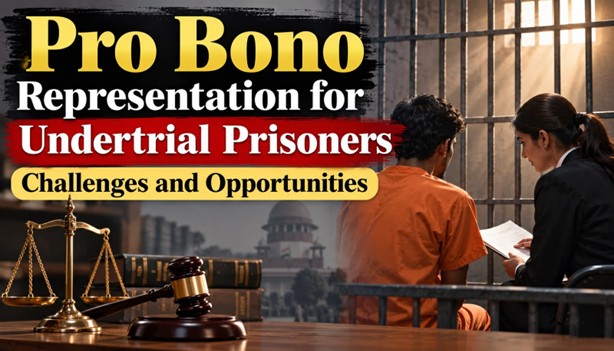
Imagine spending months or years in a prison for an offence that has not yet been proved against you. You are waiting for your trial, but every time there’s another disappointment and another date. You are unable to afford a lawyer; your family is financially weak. Unfortunately, this is the reality faced by many undertrial prisoners in India.
The fundamental principle in criminal law is “Ei incumbit probatio qui dicit, non qui negat” (every person is innocent until proven guilty), known as the presumption of innocence. However, this principle is difficult to experience in practical life for many undertrial prisoners.
This is where pro bono legal representation becomes important. The term pro bono comes from the Latin phrase pro bono publico, which means “for the public good.” In simple terms, it refers to the free legal services provided by advocates for people who cannot afford advocates.
Pro bono is very important for undertrial prisoners because it helps them understand their legal rights, apply for bail, and have a fair trial. Many undertrial prisoners don’t know about legal procedure; by providing them pro bono, it becomes very easy for them to have a fair trial.
Understanding the Plight of Undertrial Prisoners
An undertrial prisoner is a person who is in judicial custody while criminal proceedings against them are pending. According to Prison Statistics India 2022, published by the National Crime Records Bureau (NCRB), India had 4,34,302 undertrial prisoners as of 31 December 2022. They accounted for approximately 75.8 per cent of the country's total prison population recorded that year. These figures highlight the scale of the issue and raise important questions about delays in criminal trials and access to legal assistance.
A person who cannot afford a private lawyer may depend entirely on legal aid services. However, merely appointing a lawyer does not necessarily mean that the person will receive effective representation. The lawyer must have sufficient time to understand the case, communicate with the accused and take the necessary legal steps. When this does not happen, an undertrial prisoner may remain in custody longer than necessary.
The issue, therefore, is not only about the number of people in prison. It is also about whether the legal system is doing enough to ensure that every accused person has a meaningful opportunity to defend themselves.
The Constitutional and Legal Framework
The Indian Constitution recognises that justice should be accessible to everyone, regardless of their financial circumstances. Several constitutional provisions and judicial decisions support the right to legal assistance.
Article 21 guarantees the right to life and personal liberty
Over the years, the Supreme Court has interpreted this provision to include important safeguards relating to fair procedure and speedy trial. For an undertrial prisoner, these protections are particularly significant because unnecessary delays can result in the continued loss of liberty.
One of the landmark judgment Hussainara Khatoon v. Home Secretary, State of Bihar (1979). In this case, the Supreme Court drew attention to the condition of undertrial prisoners who had remained in custody for long periods without their trials being completed. The Court recognised the importance of speedy trial as part of the protection guaranteed under Article 21.
Article 39A of the Constitution
Article 39A is part of the Directive Principles of State Policy (Part IV of the Constitution). It directs the State to ensure that the legal system promotes justice based on equal opportunity and specifically requires the provision of free legal aid so that no citizen is denied justice due to economic or other disabilities.
Article 22
Provides important safeguards for arrested persons, including the right to consult and be defended by a legal practitioner of their choice, subject to the applicable constitutional provisions.
The Legal Services Authorities Act, 1987
Provides the statutory framework for free legal services in India. Under Section 12, persons in custody are among the categories eligible for legal services, subject to the applicable provisions of the Act. Institutions such as the National Legal Services Authority (NALSA), State Legal Services Authorities and District Legal Services Authorities work to make legal assistance available to eligible individuals.
These provisions show that legal aid is not merely an act of kindness. It is an important part of India's commitment to equal justice. Pro bono initiatives can support this framework by extending the reach of legal assistance and helping undertrial prisoners access their rights in practice.
Challenges in Providing Pro Bono Representation
1. Lack of Awareness About Legal Rights
One of the biggest challenges in India is that many undertrial prisoners are unaware of the legal assistance available to them. Some do not know that they can receive free legal aid because they are in custody; most of them are not educated or don’t have enough knowledge about their rights. Others may not understand the bail process or their rights during trial.
This lack of awareness can leave prisoners dependent on others to explain their situation. If they do not receive timely information, they may miss opportunities to seek appropriate legal remedies and it may affect their life entirely or in many ways.
Lawyers and legal aid organisations can help address this problem by conducting prison visits, organising legal awareness programmes and explaining legal procedures in simple language.
2. Delays in Trials and Bail Proceedings
Delays in criminal proceedings are another major concern. Court backlogs, delays in investigations and difficulties in securing witnesses can all contribute to the slow progress of cases.
For someone in prison, every day feels like a year and every delay affects their life. The person may lose their job and struggle to support their family. Of course, bail is not automatic and depends on the facts and applicable law. Nevertheless, timely legal advice can help ensure that a prisoner's circumstances are properly considered.
3. Limited Resources and Institutional Support
Pro bono work is voluntary, but it still requires time, effort and resources. Lawyers need to travel to prisons, obtain documents, research legal questions and attend court hearings. Managing these responsibilities alongside regular professional work can be difficult.
Individual advocates may also find it challenging to follow a case over several months or years without institutional support. As a result, some initiatives may remain small or struggle to provide continuity. This is why pro bono work should not depend entirely on the goodwill of individual lawyers. Stronger cooperation with legal aid institutions, law firms and universities can make such efforts more organised and sustainable.
Opportunities to Improve Pro Bono Representation
Although the challenges are considerable, there are several ways in which pro bono representation can be strengthened and made more effective.
1. Greater Participation by Lawyers and Law Firms
Lawyers play an important role in making justice accessible to those who cannot afford it. By taking up selected cases voluntarily, advocates can help undertrial prisoners to get professional legal help and seek justice. Law firms can also establish structured pro bono programs in which lawyers contribute a certain amount of professional time to public-interest work. Such programs can provide greater continuity than isolated voluntary efforts.
2. The Role of Law Schools and Legal Aid Clinics
Law schools can add valuable contribution in the field of legal aid by providing internships to law students, where students can assist advocates in legal aid matters by preparing case briefs, maintaining documents, etc. It also helps advocates maintain their time; students gain experience and undertrial prisoners get free legal aid. These activities can benefit students as well as prisoners.
3. Regular Review of Undertrial Cases
One practical way to address prolonged detention is to ensure that undertrial cases are reviewed regularly. Undertrial Review Committees play an important role in identifying prisoners whose cases may require attention under applicable legal provisions.
Regular review can help bring overlooked cases to the attention of the relevant authorities. Every case must, of course, be assessed on its own facts. The objective is to ensure lawful and timely consideration, not automatic release in every situation.
Conclusion
Pro bono representation for undertrial prisoners is about more than providing free legal services. It is about ensuring that the promise of justice reaches people who are often the least equipped to fight for it.
Lawyers, law schools, legal aid institutions and civil society organisations can work together to address these problems.
Ultimately, the purpose of pro bono representation is not simply to offer a service without charging a fee. It is to ensure that every person, irrespective of their financial condition, should get justice and equal treatment. Every person is equal in the eyes of the law.
Justice should not be a privilege reserved for those who can afford it.
References
1. Constitution of India, Articles 21, 22 and 39A.
2. Legal Services Authorities Act, 1987, Sections 12 and 13.
3. Hussainara Khatoon v. Home Secretary, State of Bihar (1979).
4. National Crime Records Bureau, Prison Statistics India 2022.
5. National Legal Services Authority (NALSA), https://nalsa.gov.in/
Conclusion
Pro bono representation for undertrial prisoners is about more than providing free legal services. It is about ensuring that the promise of justice reaches people who are often the least equipped to fight for it.
Lawyers, law schools, legal aid institutions and civil society organisations can work together to address these problems.
Ultimately, the purpose of pro bono representation is not simply to offer a service without charging a fee. It is to ensure that every person irrespective of there financial condition should get justice and equal treatment. Every person is equal in eyes of law.
Justice should not be a privilege reserved for those who can afford it.
References
- Constitution of India, Articles 21, 22 and 39A.
- Legal Services Authorities Act, 1987, Sections 12 and 13.
- Hussainara Khatoon v. Home Secretary, State of Bihar (1979).
- National Crime Records Bureau, Prison Statistics India 2022.
National Legal Services Authority (NALSA), https://nalsa.gov.in/